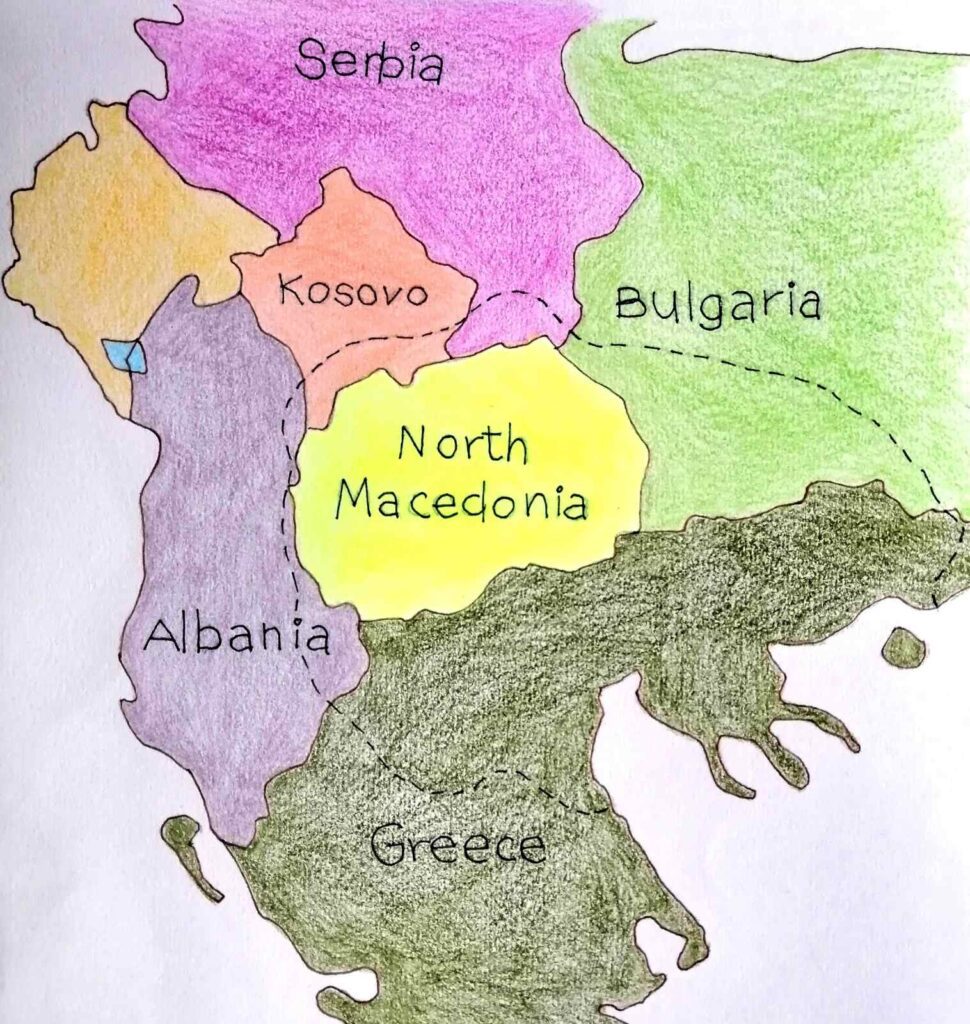
This is not to convey that there are no words and phrases connected with the Serbian, Bulgarian, or even Russian typical languages in the language, but somewhat that they ended up discouraged on a basic principle of "looking for indigenous product to start with".[96]
On this poster presentation at 57th Annual Conference on the Societas Linguistica Europaea in Helsinki, through the viewpoint of comparative-historic Slavic linguistics and areal-typological Balkan linguistics, improvements inside the territorial dialects from the Orthodox Serbian inhabitants in Metohija are examined. These innovations are possible induced by prolonged connection with the Albanian language, like its neighborhood territorial dialects, at all amounts of linguistic structure: phonetic-phonological, morphonological, morphological and morphosyntactic, syntactic, lexical, and phraseological.
Testimonials. , in the direction of a market economy. Even so, several improvements to many of the formal features on the publication as well as a sharpening of its focus would certainly are actually useful.
Along with its Principal capabilities, the imperative is employed to indicate actions in past times, eternal truths as is the situation in sayings and a problem. The Macedonian conditional is conjugated in the exact same way for all a few persons using the particle би and also the verbal l-type, би читал (I/you/he would read through).[80]
A vital theoretical concern is elevated with regards to the potential of discriminating, through strictly linguistic techniques, the outcomes of language contact from developments affected by internal factors. This consists of revolutionary alterations during the inventory and distribution procedures of phonemes, grammatical units (markers), categories, lexical, and phraseological composition of your language. The potential function of Get hold of in preserving archaisms in language framework is usually regarded as.
Even though it is predicated at Ca’ Foscari University of Venice, the Journal aims at giving a world tutorial platform wherever Students and scientists working inside of equally the normal and the greater recently produced experimental frameworks can share novel Concepts and progress theoretical proposals in the sphere of Slavic and Balkan linguistics.
Grammar on the language from the Slavic Macedonian population written by Georgi Pulevski in 1880 marks the first endeavor at standardisation for that Macedonian language while in the Galičnik dialect. The time period between 1840 and 1870, observed a battle to outline the dialectal base on the widespread language termed basically "Bulgarian", with two opposing sights emerging.
Variations in consonant pronunciation occur amongst the two teams, with most Western locations getting rid of the /x/ plus the /v/ in intervocalic posture (глава (head): /ɡlava/ = /ɡla/: глави (heads): /ɡlavi/ = /ɡlaj/) although Japanese dialects maintain it. Strain while in the Western dialects is usually fixed and falls to the antepenultimate syllable though Japanese dialects have non-fixed strain techniques that can slide on any syllable of the phrase,[67] that is certainly also reminiscent of Bulgarian dialects.
Zuvor waren mazedonische Varietä10 in den 1930er und der ersten Hälfte der 1940er Jahre mit individuellen Adaptationen der serbischen oder bulgarischen Kyrilliza geschrieben worden.[31] Kyrillisch
Länder, in denen Muttersprachler einen Anteil von nur wenigen tausend oder gar hundert Menschen haben oder Länder mit einem Anteil deutlich unter one% werden hier nicht mehr gelistet.
Krste Petkov Misirkov's guide Za makedonckite raboti (On Macedonian Issues) published in 1903, was the 1st try to formalize a individual literary language.[forty five] Along with the guide, the writer proposed a Macedonian grammar and expressed the goal of codifying the language and employing it in colleges. The writer postulated the basic principle that the Prilep-Bitola dialect be utilised as a dialectal basis for that development from the Macedonian common language; his strategy on the other hand wasn't adopted right up until the nineteen forties.
[86] The direct item is often a remnant on the accusative case and the oblique in the dative. Reflexive pronouns also have varieties for equally direct and oblique objects: себе се, себе си. Examples of individual pronouns are revealed under:
In the course of the standardization procedure, there was deliberate treatment taken to try to purify the lexicon with the language. Words and phrases that were associated with the Serbian or Bulgarian standard languages, which experienced turn out to be prevalent due to the influence of these languages during the location, were rejected in favor of phrases from native dialects and archaisms.
Balcania et Slavia. Studi linguistici
There is no difference in this means, Even though the latter type is a lot more usually Utilized in spoken language. One more long term tense is long term previously that's shaped using the clitic ќе as well Mazedonische Sprache as previous tense of the verb inflected for man or woman, таа ќе заминеше ("she would have remaining").[80]
The current tense Mazedonien Sprache in Macedonian is shaped by incorporating a suffix into the verb stem that is inflected per particular person, sort and range of the topic. Macedonian verbs are conventionally divided into three primary conjugations based on the thematic vowel Utilized in the citation variety (i.
Welche Sprache spricht man in Mazedonien?
Viele Menschen stellen sich die Frage: Welche Sprache spricht man in Mazedonien? Die offizielle und am weitesten verbreitete Sprache ist Mazedonisch. Sie wird von der Mehrheit der Bevölkerung als Muttersprache gesprochen und dient als Amtssprache in Verwaltung, Politik, Bildung und Medien. Im alltäglichen Leben ist Mazedonisch allgegenwärtig und verbindet Menschen unterschiedlicher Generationen.
Neben der mazedonischen Sprache existieren jedoch weitere Sprachen, die von ethnischen Minderheiten gesprochen werden. Besonders Albanisch nimmt eine bedeutende Stellung ein und wird in bestimmten Regionen auch offiziell verwendet. Diese sprachliche Vielfalt ist ein charakteristisches Merkmal Mazedoniens und zeigt die multikulturelle Struktur des Landes.
Mazedonische Sprache: Herkunft und Besonderheiten
Die Mazedonische Sprache gehört zur südslawischen Sprachfamilie und ist eng mit dem Bulgarischen und Serbischen verwandt. Trotz dieser Nähe besitzt sie eine eigenständige grammatikalische Struktur und einen eigenen Wortschatz. Geschrieben wird Mazedonisch mit dem kyrillischen Alphabet, das speziell an die Lautstruktur der Sprache angepasst wurde.
Ein besonderes Merkmal der mazedonischen Sprache ist ihre vergleichsweise einfache Grammatik im Vergleich zu anderen slawischen Sprachen. Bestimmte Artikel werden direkt an das Substantiv angehängt, was sie von vielen europäischen Sprachen unterscheidet. Diese sprachlichen Eigenschaften machen Mazedonisch sowohl einzigartig als auch interessant für Sprachwissenschaftler.
Sprache in Mazedonien: Alltag und Mehrsprachigkeit
Die Sprache in Mazedonien ist stark von Mehrsprachigkeit geprägt. Aufgrund der ethnischen Vielfalt des Landes werden im Alltag häufig mehrere Sprachen parallel verwendet. In vielen Städten ist es üblich, dass Menschen Mazedonisch und Albanisch oder andere Sprachen fließend sprechen.
Die mazedonische Verfassung erkennt die sprachlichen Rechte von Minderheiten an, was zu einem offenen und inklusiven Sprachsystem geführt hat. In Schulen, öffentlichen Institutionen und sogar im politischen Diskurs ist Mehrsprachigkeit fest verankert. Diese Praxis trägt dazu bei, den sozialen Zusammenhalt zu stärken und kulturelle Unterschiede zu respektieren.
Sprachentwicklung im Balkanraum: Historische Einflüsse
Die Sprachentwicklung im Balkanraum ist das Ergebnis jahrhundertelanger historischer Prozesse. Der Balkan war stets ein Schnittpunkt verschiedener Kulturen, Völker und Reiche. Diese kontinuierlichen Begegnungen führten dazu, dass sich Sprachen gegenseitig beeinflussten und gemeinsame Strukturen entwickelten.
Auch die mazedonische Sprache wurde durch diese Entwicklungen geprägt. Sie enthält zahlreiche Lehnwörter aus dem Türkischen, Griechischen und Albanischen. Gleichzeitig teilt sie grammatikalische Merkmale mit anderen Balkan-Sprachen, obwohl diese unterschiedlichen Sprachfamilien angehören. Dieses Phänomen macht den Balkan sprachwissenschaftlich besonders interessant.
Historische Entwicklung der mazedonischen Sprache
Die mazedonische Sprache wurde erst Mitte des 20. Jahrhunderts offiziell als eigenständige Sprache anerkannt. Im Jahr 1945 begann die Standardisierung, bei der eine einheitliche Grammatik und Rechtschreibung festgelegt wurden. Dieser Prozess war entscheidend für die Entwicklung einer modernen Literatursprache.
Seitdem hat sich Mazedonisch stetig weiterentwickelt und ist heute in Literatur, Journalismus, Film und digitalen Medien präsent. Die Sprache wurde zu einem wichtigen Symbol nationaler Identität und kultureller Selbstbestimmung.